Origin of good ideas
Key insights and lessons gleaned from Steven Johnson's timeless work, "Where Good Ideas Come From."

I am nervous and excited at the same time while publishing this inaugural newsletter. What would be a better start to this enthralling journey than delving into the realms of innovation and ideas—an influential force steering the advancement of our world. To explore the goals and purpose of this newsletter in-depth, I invite you to check out this post.
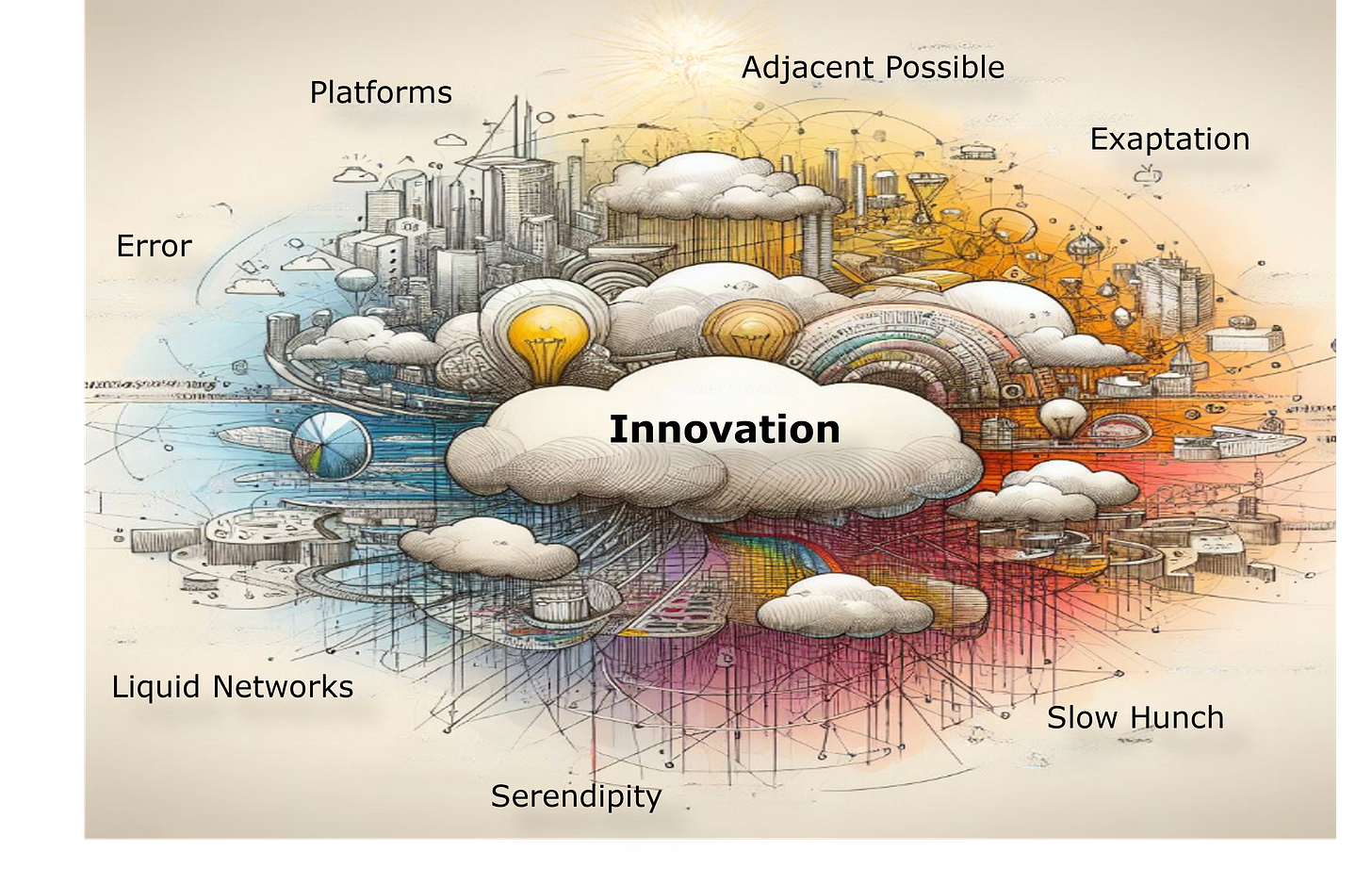
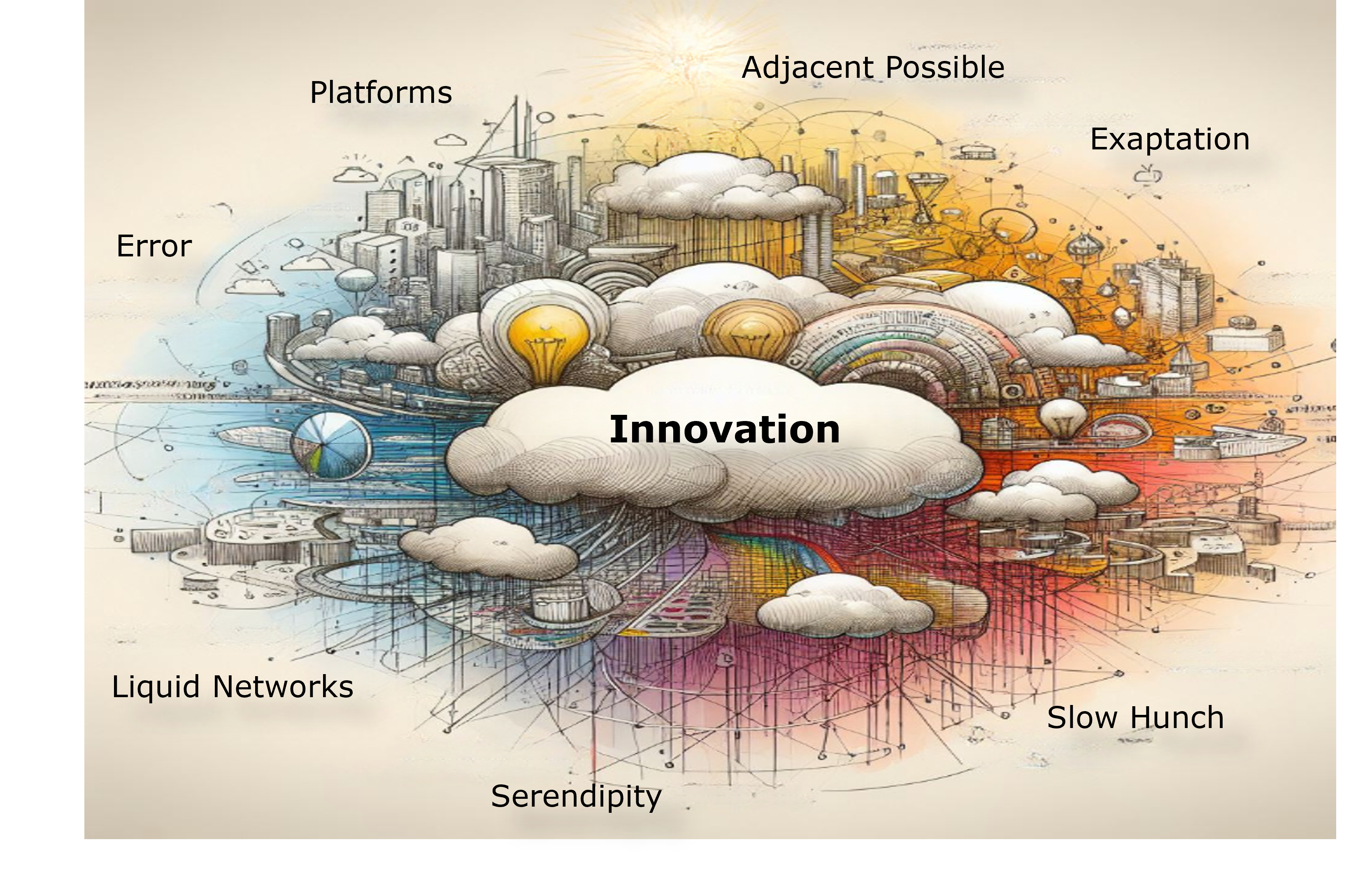
As we embark on this journey together, I'm eager to explore the valuable insights offered by Steven Johnson's book - "Where Good Ideas Come From". This book isn't just another read; it holds a wealth of wisdom that can subtly influence our approach to product building. In the vast landscape of innovation, where each idea carries the potential for transformation, let's engage in a discourse on the seven interconnected components that lie behind all innovation. The seven components are: Adjacent Possible, Liquid Networks, Slow Hunches, Serendipity, Error, Exaptation and Platforms. Each component builds upon and extends the others, exemplifying the notion that “the whole is greater than the sum of its parts.” As we explore each component in depth, I will endeavor to decipher how we can integrate the insights from these gems into our daily work.
In the product world we spend a considerable amount of time doing product discovery work. We have the problem space and the solution space and while we are taught to be creative in exploring the solution space, we can easily go astray with our idea generation process. The seven components described below can help us be more methodical and focused in exploring the solution space.
Adjacent Possible - The concept of the "adjacent possible" refers to a potential future that exists at the fringes of the current state of affairs. To illustrate, consider a child's language acquisition journey: once the child grasps the alphabets, their adjacent possible realm includes two-letter and three-letter words. Progressing further, as the child masters these shorter words, the boundaries of their adjacent possible expand to encompass small sentences, longer words, and beyond. Any innovative idea driving progress must align with this evolving adjacent possible territory. Despite the boundless capacity of the human mind, attempting to introduce ideas that skip crucial exploratory steps within the adjacent possible often leads to short-term failures. Expanding on the analogy of a child learning language, trying to teach complex sentences immediately after learning the alphabet would likely result in an unsuccessful endeavor.
The tech landscape abounds with instances where ideas bypassed the exploration of the adjacent possible, resulting in short-term failures. Notable examples include Google Glasses, the Metaverse, and Microsoft Cortana. Some stumbled due to immature technology, others due to exorbitant component costs, and yet others due to unprepared underlying infrastructure.
When encountering a visionary idea that appears too ambitious, it serves as a cue to subject it to an adjacent possible assessment. If a new concept necessitates a leap from 0 to 1 on multiple frontiers, it suggests that the essential components for its success are still evolving. In such scenarios, consider letting the idea enter a state of dormancy, akin to a "slow hunch" (as discussed later), awaiting the maturation of the right ecosystems and platforms (also discussed later) to foster its growth. The 'Adjacent Possible' concept serves a dual purpose: firstly, it aids in discarding ideas that appear excessively esoteric, and secondly, it enables exploration along the edges of the current state of affairs, uncovering concepts with the potential to foster tangible growth.Liquid Networks - A system of interconnected components generating innovative ideas often finds its optimal state at the "edge of chaos," a dynamic zone balancing between excessive order and total anarchy. Drawing parallels to the three phases of matter—Gas, Liquid, and Solid—an analogy can be drawn: a gaseous network state generates novel configurations, but they are consistently disrupted. Conversely, a solid state provides stable patterns but lacks the capacity for change. In contrast, a liquid state within a network fosters a conducive environment for exploring the adjacent possible, offering both stability and the flexibility to adapt and evolve.
In our quest for solutions, we often grapple with the temptation to impose established frameworks and best practices onto our unique situations. Liquid networks, as a guiding principle in navigating the solution space, underscores two pivotal attributes. The first attribute involves the ability to forge new connections, underlining the flexibility of the elements within solution space to form dynamic bonds with other elements. The second attribute revolves around fostering a randomizing environment, encouraging collisions among elements and igniting unforeseen ideas.
In the technological landscape, liquid networks take on diverse forms, from open office plans to cross-functional teams. A prime illustration is found in the innovative culture cultivated at Xerox PARC (Palo Alto Research Center Incorporated), showcasing the principles of a liquid network through interdisciplinary collaboration and the facilitation of connections among researchers from different fields. This approach at Xerox PARC yielded groundbreaking innovations, including the development of the graphical user interface (GUI) and the mouse, reshaping the computing landscape.
To harness the power of liquid networks a practical and effective approach that has helped me in the past involves establishing a cross-functional working committee. This is especially handy when addressing sizable and intricate problems. Such a committee strikes a delicate balance between order and flexibility, fostering an environment conducive to generating unexpected ideas while maintaining forward momentum in execution. Embracing the principles of liquid networks, this approach encourages diverse perspectives, collaborative problem-solving, and the exploration of the adjacent possible.
Slow Hunch - Most great ideas first take shape in a partial, incomplete form. These are the slow hunches, ideas brimming with hidden power but needing time and careful nurturing to blossom into true breakthroughs. Slow hunches take a long time to mature and turn into breakthrough innovations. The liquid networks discussed earlier play a pivotal role in catalyzing the completion of these slow hunches. But until these hunches turn into breakthroughs, they face a constant threat of evaporation.
Often times when you have worked with a product long enough, it's common to develop intuitive hunches about crucial features the product might be lacking or vague ideas that could propel it towards 10x growth. Unfortunately, these valuable hunches often fade away gradually, resulting in missed opportunities to create a profound impact. To guard against these gradual decay of hunches, a systematic approach to organize and cultivate these partial ideas becomes essential.
Enter the Zettelkasten, an organization system I use and recommend. Developed by sociologist Niklas Luhmann, this note-taking method provides fertile ground for slow hunches to flourish. Think of it as a personal greenhouse for ideas, where each idea is meticulously documented and tagged, then interwoven with others through a web of connections. As you add new notes, the network grows, revealing surprising cross-pollination and serendipitous connections. Imagine that product hunch gnawing at the back of your mind. With the Zettelkasten, you capture it on a note, link it to relevant concepts, and watch as unexpected connections emerge. Perhaps a seemingly unrelated note on user psychology sparks the missing element, igniting the hunch into a full-fledged innovation. The Zettelkasten's beauty lies in its organic growth. Unlike rigid outlines or linear lists, it fosters a dynamic ecosystem of ideas, encouraging exploration and unexpected discovery. It's not just about storing hunches; it's about transforming them, nurturing them into their most potent form. To delve deeper into this powerful method, follow this link.
Serendipity - A word that captures the power of accidental connection. It completes a slow hunch or opens a door to the adjacent possible that you had overlooked. But serendipity isn't purely a roll of the dice, its a dance between chance and preparation. While it thrives on unlikely collisions and surprise discoveries, it also needs an anchor. This is where your system for organizing slow hunches comes in – the anchor that secures these nascent possibilities, keeping them readily accessible for serendipitous encounters. Imagine stumbling upon a revolutionary new material while tinkering with an unrelated experiment or landing on the missing piece of a complex engineering puzzle through a chance conversation with a stranger. These are the sparks of serendipity, illuminating the path to the "adjacent possible" you never knew existed.
The history of innovation is littered with tales of serendipity. The humble Post-it note, a testament to a chance meeting between a weak adhesive and a bookmarked hymnal page. The revolutionary microwave oven, sparked by a chocolate bar melting in a scientist's pocket near a radar machine. And of course, the life-saving penicillin, born from a forgotten mold on a petri dish – a clear reminder that groundbreaking discoveries often lie at the intersection of the unexpected and the meticulously prepared.Although often dismissed as mere luck, serendipity lacks a prescribed formula for enhancement. Yet, the probability of fostering serendipitous connections can be heightened by intentionally disrupting routine. When crafting a strategy document, creating a go-to-market plan, or grappling with a complex problem, break free from the confines of your routine. Take a walk, attend a lecture on an entirely different topic, engage in conversations with people from diverse backgrounds, or delve into a book on a subject you know nothing about. It's in these unexpected corners that the seeds of serendipity often lie dormant, waiting to be awakened by the curious explorer. With the advent of AI and machine learning, the possibilities for amplifying serendipity become even more tantalizing. Imagine intelligent algorithms sifting through your seemingly unrelated ideas, spotting hidden connections, and suggesting unexpected collaborations. These "smart nudges" can act as catalysts, accelerating the serendipitous dance of discovery. Forget luck, embrace system. Cultivate curiosity, break routines.
Error - The history of being spectacularly right has a shadow history behind it of being spectacularly wrong, again and again. Many inventions in history depended on generative mistakes that were generative precisely because they connected to slow hunches in the minds of their creator. Being right keeps you in place but being wrong forces you to explore. When we’re wrong we have to challenge the assumptions and adopt new strategies. Being wrong, in itself, doesn't automatically unlock new doors to the adjacent possible, but it compels us to seek them out—a principle encapsulated in the mantra 'fail fast.'
In the fast-paced world of technology, we tend to treat errors as anomalies, something to quickly dismiss and move past. We blame "one-offs" and rarely delve deeper, clinging to our rigid mental models of the world. But our rigid mental models, those pre-formed lenses through which we view the world, often act as blinders, preventing us from truly seeing the lessons these missteps offer. Imagine a product manager meticulously building a feature based on a carefully crafted hypothesis. When real-world usage data paints a different picture, instead of discarding the feature as a failure, consider it a generative mistake. This "wrong turn" might hold the key to a groundbreaking innovation, a hidden gem obscured by the ashes of perceived failure. Many technological breakthroughs like Teflon, X-rays and even transistors owe their existence to an error. In certain respects, serendipity and error share an inseparable bond, akin to conjoined.
Exaptation - In pure sense, exaptation means an organism develops a trait optimized for specific purpose, but then the trait gets hijacked for a completely different function. This allows organisms to adapt to new environments and challenges by reusing existing features. Similarly, in the realm of innovation, exaptation can help us discover new applications and solutions by combining ideas from different domains. If error and serendipity unlock new doors in the adjacent possible, exaptation help us explore the new possibilities that lurk behind those doors. Exaptation flourishes in a network characterized by weak ties between its nodes. Weak ties not only facilitate efficient information flow but also spur the exchange of information from a diverse idea space - a vibrant tapestry woven from tools, beliefs, metaphors, and objects of study. Strong ties, like closely related concepts, confine you within familiar territories. But weak ties, like seemingly disparate threads, act as bridges to uncharted corners of this space. This is where exaptation thrives.
One of the finest examples of exaptation is the world wide web. Invented by Tim Berners-Lee while working at CERN, the World Wide Web was initially conceived to share research documents between scientists. Its unexpected adoption by the general public, leading to the internet boom, transformed communication and information access globally. So, how can you tap into this power? Keep an eye on your users. Their workarounds, their unexpected uses of your features, are whispers of exaptation waiting to be heard. These user-driven adaptations serve as organic indicators of potential groundbreaking ideas, as users uncover novel applications for existing solutions. Its like your users handing you the keys to the hidden value in your product. Exaptation is often obscured in what we call Pivots in the product world. For instance, Discord, initially conceived as the online multiplayer game Fates Forever, underwent a pivot prompted by exaptation of its voice and chat features for communication, leading to Discord's transformative evolution.
Platforms - Platforms embody a fascinating exercise in emergent behavior within the realm of technology and innovation. When one entity performs a specific action driven by its own interests, it inadvertently creates a platform that other entities can exploit. In the grand scheme, platform builders and ecosystem engineers don't merely open a door in the adjacent possible; they construct an entire new floor. Most generative platforms, like the world wide web, rise in layers. Think of it as a digital Lego set, where each piece – APIs, SDKs, development tools – snaps together, forming a base for endless innovation. This layered structure unlocks the true power of emergent platforms – the cost of creation plummets. Beyond cost reduction, platforms introduce a dynamic of recycling, where what might be considered waste to one becomes treasure to another, fostering synergies and collaborative innovation. What is commonly known as "Network Effects" in the technology domain also owes its existence to platforms. The flourishing of developers and startups on AWS, for instance, results in an expanded array of services it can offer, illustrating the virtuous cycle of platform-driven growth and innovation. In today's world platforms serve as catalysts for a multitude of interconnected services and solutions. Think of iOS and Android app stores, AWS, Google Maps, Shopify, Stripe, Twilio, Github, Zapier and others.
For product teams, the platform approach offers a powerful lens through which to view their work. It's all about maximizing leverage – the impact produced per unit of effort. Leverage can be amplified by tapping into existing platforms, whether internal or external. When seeking solutions, don't reinvent the wheel. Look outward, towards existing internal and external platforms. Can your challenge be addressed by leveraging the capabilities of others? Can you plug into existing APIs or tools, accelerating your journey towards a solution? Conversely, when developing a solution, think beyond individual success. Can your new data analysis tool be expanded to serve other teams? Can your mobile app's core functionality be repurposed for a different market? Explore ways to assimilate your solution into existing internal platforms, reducing the cost of future endeavors. By embracing modularity and adaptability, you sow the seeds for future ecosystems. I know this firsthand – while optimizing a lengthy process, I built a modular "Job Framework" instead of a one-off solution. Result? All our long-running processes now hum on that platform. By embracing the emergent nature of platforms, maximizing leverage, and looking beyond individual solutions, product teams become architects of the future. They don't just build products; they build ecosystems where innovation thrives.